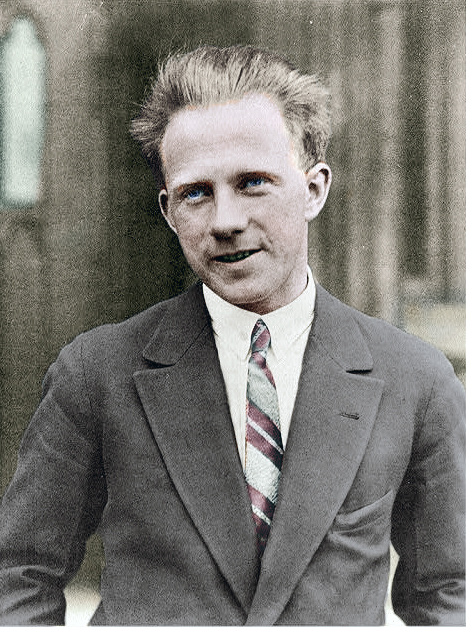
Werner Karl Heisenberg (1901 – 1976) was a German theoretical physicist and a pioneer of quantum physics. Better know for the Heisenberg uncertainty principle. In addition, he also published works on philosophy and metaphysics. This page explores his insights on the impact of quantum mechanics to the way humanity conceives the universe.
Foundations of Exact Science
“Classic physics … was built on some fundamental suppositions which appeared to be obvious starting points of all exact science and seemed to require neither proof nor discussion: physics dealt with the behavior of matter in space and its change in time.”
“… One was led to the tacit assumption that there existed an objective course of events in space and time, independent of observation; further, that space and time were categories of classification of all events, completely independent of each other, and thus represented an objective reality, which was the same to all men.”
The assumptions of classical physics were first challenged by Einstein’s theory of relativity, but it was the Michelson-Morley experiment what provided evidence for the contradictions of classical physics. “Science was force to admit that one of the assumptions of the classical interpretation was not based on any direct observation… I refer of course to the assumption which declares two events simultaneous even if they do not occur in the same place. We call events past if we can, at least in principle, find out about them through some observation. We call them future if we can, at least in principle, intervene in their course. It corresponds with our daily experience to believe that events capable of observation are separated from those still open to change only by an infinitely short instant which we call present.
The special theory of relativity showed the position of the observer is a determining factor in the perception of the past and future. “… a consistent pursuit of classical physics forces a transformation in the vary basis of this physics … Modern theories did not arise from revolutionary which have been introduced into the exact science from the outside. On the contrary they have forced their way into research which was attempting to consistently carry out the programme of classical physics…”
Note: By means of experimental demonstration all the postulates of classical physics were tested until contradictions were revealed.
 NoteBook