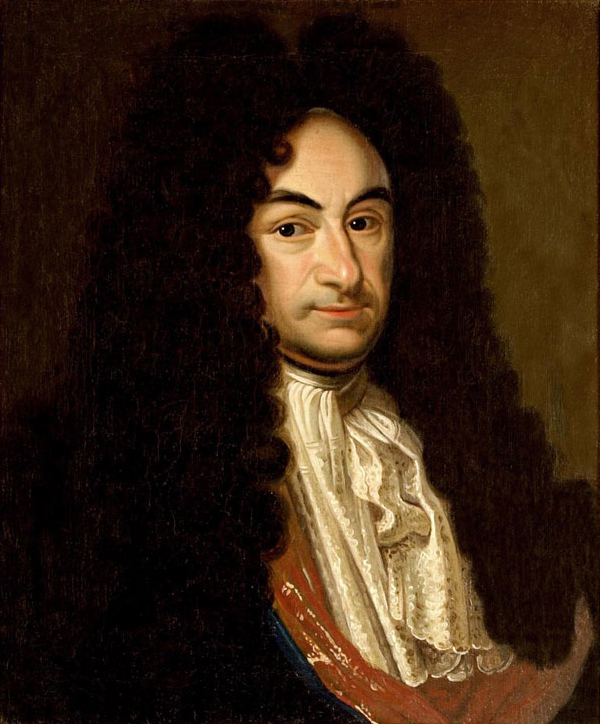
Gottfried Wilhelm von Leibniz (1646 -1716) was a German polymath (mathematician, philosopher, scientist and diplomat). He is referred as the “last universal genius”. Most people know of his works in calculus, physics and computer science. His works in philosophy are little known. This page is dedicated to explore his philosophical thoughts.
Leibniz philosophy is known as rationalism. This was a movement which began with Descartes. Rationalism is a methodology or theory “in which the criterion of the truth is not sensory but intellectual and deductive.” Rationalism as opposed to empiricism, believed reality has an intrinsic logical structure, because of this they believe that certain truths exist and that intellect can directly grasp these truths.
It may come to a shock of many readers that Leibniz, like Descartes, believed in a “divine being”, God. Which might prompt the question: what is God for the rationalists? To better illustrate the answer to this question consider the following:
Set theory is an axiomatic theory which, as the name indicates, has a set of axioms (truths) and by applications of logic and properly defining it’s objects all the theorems of the theory are revealed. A peculiar aspect of the axioms is that they must assume the existence of a particular set “the empty set”. The remaining axioms deal with set operations, how new sets are to be created and how to handle paradoxes. Set theory can construct the natural numbers (Neumann and Cantor) and subsequently into every other set of numbers (integers, rationals, reals, etc). Now having the numbers, Peano arithmetic and the Godel code can be “created”. Last, the Godel code can represent most of the spoken language which has a logical structure. It could be said that” the empty set has all the properties of set theory” or “it allows for the existence of all other sets”.
Since rationalists believe the universe has a logical structure, in like fashion to set theory, there must be an entity which “has all the properties” or “allows for all the properties to exist” and through the “universal” truths the universe is “rationalized” into existence. This entity is called God.
Introduction
“… It is important once and for all to examine all our assumptions in order to establish something solid. For I hold that it is only when we can prove everything we assert that we understand perfectly the thing under consideration.”
Primary truth: the existence of possibility and necessities.
Notation: Possibly ” ◊ ” Necessarily ” □ “. Let some notion P be possible then it is written as ◊P .
“… what we call essences or natures and the truths we commonly call eternal -and we are right to call them so, for there is nothing so eternal as that which is necessary. Thus the nature of the circle with its properties is something existent and eternal. That is, there is a constant cause outside us which makes everyone who thinks carefully about the circle discover the same thing.”
General truth 1: we think.
This is Descartes famous “Cogito ergo sum” (I think, therefore I exists). Anything in nature can be doubted, whether by claiming we fail to recognize the nature of the objects or our sense failing to tell the truth; even the existence of the mind can be doubted. However doubting itself is an act of thinking, therefore thinking can’t be doubted. Last, thinking is a property of existing beings, hence thinking is the proof of our existence. Ironically philosophers nowadays doubt whether “I” is the thinking being, since thinking could be happening outside of “I”.
General truth 2: there is variety in our thoughts.
This follows from the fact that we doubt many things, hence the variety. Leibniz claims this is the proof of existing things outside our mind, since the mind would remain in the same state unless it is altered by something external to it. “This variety cannot come from that which thinks, since the single thing by itself cannot be the cause of the changes in itself.” This statement is reminiscent of the action-reaction effect of moving bodies: objects remain in rectilinear motion at constant speed unless they collide with another object (First Law of Motion).
Freedom and Possibility
“A volition[voluntas] is an endeavor[conatus] for acting of which we are conscious.” A volition follows when all the requisites for acting excess the requisites for not acting. It is possible to resist reason.
Proposition 1: There is nothing without reason. Alternatively there is no proposition in which there is no connection between the subject and the predicate.
Proposition 2: The principle of necessary things. Whatever implies a contradiction is false.
Proposition 3: The principle of contingent things. Whatever is more perfect or has more reason is true.
Note: Consider two sentences: (1) “The color red is walking.” (2) “The color red is beautiful.” (1) seems absurd since red is not associated with walking while it makes more sense to be associated with beautiful in (2).
All truths concerning possibles or essences and the impossibility of a thing or its necessity (that is, the impossibility of the contrary) rest on the principle of necessary things. An example are the propositions of logic, arithmetic and geometry which are shown to imply contradictions if someone denies them.
Note: If someone claims the sum of the interiors angles of a triangle doesn’t adds up to 180 it can be proven that this leads to a contradiction.
All truths contingent by their nature rest on the principle of contingent things. Except for the existence of God alone, all existences are contingent. The reason why some particular contingent things exits, rather than others, should not be sought in its definition alone, but in comparison with other things. There is an infinite number of possible things which nevertheless don’t exists. The reason why some exists rather than others should not be sought in their definition (for then nonexistence would imply a contradiction), but rather from an extrinsic source, namely, from the fact that the ones that do exist are more perfect than the others.
Note: Consider a particular object such as a table with a squared shaped top and let it be defined this table to have a “square” top. Then if two tables are produced and one has a top closer to a square shape then the existence of the other is a contradiction by the principle of contingent things. Yet both tables exists.
Leibniz “holds a notion of possibility and necessity according to which there are some things that are possible, but yet not necessary, and which do not really exits. From this it follows that a reason that always forces a free mind to choose one thing over another does not eliminate our freedom.”
It cannot be demonstrated that God makes that which is more perfect. Let there be be two things A and B , one of which it is necessary that it exists, and lets assume there is more perfection in A than in B. Then it can be explained why A should exists rather than B and it can be rendered certain from the nature of things, and if being certain were the same as necessary then it would also be necessary for A to exist. But this necessity is hypothetical, since if it is absolutely necessary for A to exists then the existence of B would be a contradiction.
“Everything having some degree of perfection is possible and, moreover, that this happens not because of its nature but because of God’s resolve to create that which is more perfect. Perfection, or essence, is an urge for existence from which existence indeed follows per se, not necessarily, but from the denial that another thing more perfect prevents it from existing.“
Note: Review the next paragraph. *****************************
Does God will by necessity or freely? If God wills freely then there would be a will for willing on to infinity, hence he must will through his nature. Things remain possible even if God doesn’t will them to exist, since we have defined as in its nature possible anything that, in itself, implies no contradiction, even though its coexistence with God can in some way be said to imply a contradiction. But this needs further clarification.
“A possible thing is something with some essence of reality, that is, something that can distinctly be understood.”
A pentagon would remain possible even if the claim that no pentagon was or would be in nature. One could argue that this happens because a perfect pentagon is incompatible with things that include more perfection, that is, with others things that include more reality, which already exists ahead of the pentagon. So it could be inferred that it is “necessary” that it does not exist. This would be true in the sense of the proposition that: a pentagon will not exists nor has one ever existed. But, it can never be demonstrated that “no pentagon exists” abstracted from time. For a pentagon is not “absolutely impossible”, nor does it imply a contradiction, even if it follows from the harmony of things that no pentagon can find a place in nature.
Analogy of imaginary roots in algebra: Consider the equations x2 + 9 = 3x whose solution is imaginary and x+1 = x+2. Neither of the solutions to these equations can be pictured. The first is insoluble on accounts of imaginary roots while the second is insoluble due to an absurdity (namely that 1 = 2).
Difficulties concerning the foreknowledge of future contingents can be eliminated. “For God, who foresees the future reasons why some things should exists rather than others, foresees them in their cause with certain knowledge. And indeed, he has certain knowledge of them and formulates propositions that are necessary, given that the state of the world has, once and for all, been settled, that is, given the harmony of things. But the propositions are not necessary in the absolute sense, as mathematical propositions are necessary.”
” It is possible for the imperfect rather than the more perfect to exists. And so we must say that what God does not will to exist does not exist, but we must therefore deny its necessity. “
Knowledge, Truth and Ideas
“Knowledge is either obscure or clear, and again, clear knowledge is either confused or distinct, and distinct knowledge either inadequate or adequate, and adequate knowledge either symbolic or intuitive…” with intuitive knowledge is the most perfect.
A notion which is not sufficient for recognizing the thing represented is obscure, as, for example, if whenever I remember some flower or animal I once saw, I cannot do so sufficiently well for me to recognize that flower or animal when presented and to distinguish it from other nearby flowers or animals. Knowledge is clear when having the means for recognizing the thing represented.
Clear knowledge, again, is either confused or distinct. It is confused when I cannot enumerate one by one marks sufficient for differentiating a thing from others, even do the thing does indeed have such marks and requisites into which its notion can be resolved. Colors, smell and taste can be recognized but it cannot be described by explicit marks, they can only be explained by recalling past experiences.
A distinct notion is like the notion an assayer has of gold, that is, a notion connected with marks and tests sufficient to distinguish a thing from other similar bodies. Notions common to several senses, like the notion of number, magnitude, shape are usually of such kind. In other words notions for which we have nominal definitions (which is nothing but an enumeration of sufficient marks). Also one has distinct knowledge of an indefinable notion, since it is primitive, that is, since it irresolvable and it is understood only through itself and therefore lacks requisites. But in composite notions, since, again, the individual marks composing them are sometimes understood clearly but confusedly, like heaviness, color, solubility, which are among the marks of gold, such knowledge of gold may be distinct yet inadequate. When everything that enters into distinct notions is, again, distinctly known, or when analysis has been carried to completion, then knowledge is adequate.
It is difficult to grasp the entire nature of things all at once, especially in a more lengthy analysis, but in place of the things themselves we make use of signs, whose explicit explanation we usually omit for the sake of brevity, knowing or believing that we have the ability to produce it at will. For example consider a polygon with a thousand sides, we don’t always consider the nature of a side, or of equality, or of thousandfoldedness, but in our minds we use these words in a place of the ideas we have of these things, since we know the meaning of those words, and we decide an explanation is not necessary at the time. Leibniz call such thinking, which is found both in algebra and in arithmetic and, indeed, almost everywhere, blind or symbolic. And indeed, when a notion is very complex, we cannot consider all of its components notions at the same time. When we can indeed insofar as we can, Leibniz call knowledge intuitive. There is no knowledge of a distinct primitive notion except intuitive.
Note: As an example of intuitive knowledge try to express “with words” what is a straight line or a point. Both concepts can be abstracted very easily by looking at images, but the reader will find it very difficult explaining the notion of “straight”.
“From this it follows that we don’t perceive ideas of even those things we know distinctly, unless we make use of intuitive thinking. And, indeed, it happens that we often mistakenly believe that we have already explained some of the terms we use.” Whenever we say something about a thing, often, we do understand in one way or another the words in question individually or remember that we understood them previously. “But since we are content with this blind thinking and don’t pursue the resolution of notions far enough, it happens that a contradiction that might be included in a very complex notion is concealed from us.”
“We cannot safely use definitions for drawing conclusions unless we know first that they are real definitions, that is, that they include no contradictions, because we can draw contradictory conclusions from notions that include contradictions, which is absurd.”
Example 1: Suppose some “wheel turns with the fastest motion.” Every word of this sentence is perfectly understood and even the notion of “fastest motion” seem reasonable at first glance. But this notion contains a contradiction. Consider hammering a nail to the rim of the wheel. Then this nail moves faster than the wheel, but the wheel moves at the fastest speed meaning faster than the nail, which is absurd.
The scholastic argument for the existence of God. Whatever follows from an idea or definition of anything can be predicated of that thing. Since the most perfect being includes all perfections, among which is existence, existence follows from the idea of God. From this argument we can only conclude that, if God is possible, then God exists. As it was shown in example 1 just thinking about the “most perfect being” doesn’t mean we have an idea of it.
Nominal definitions: contain marks of a thing to be distinguished from other things.
Real definitions: establishes that a thing is possible.
Hobbes’ claim: truths are arbitrary, since they depend on nominal definitions.
Leibniz counter-claim: the reality of a definition is not a matter of decision and that not just any notion can be joined to one another.
Note: Consider two scenarios; in the first one it is raining in a city and the second is the same city, but it is not raining. Then chose marks to describe both, amongst these marks some that point to differences in the images. If truth is arbitrary then the marks pointing to differences can be defined to be the same, such as it is raining and not raining having the same meaning; which is absurd.
Nominal definitions are sufficient for perfect knowledge [scientia] except when one establishes in another way that the thing defined is possible. An idea is true when its notion is possible and false when it includes a contradiction. We can know the possibility of a thing either a priori or a posteriori.
A priori: when a notion is resolved into its requisites, that is, into other notions known to be possible, and we know there is nothing incompatible among them.
A posteriori: when a know through experience that a thing actually exist, for what actually exists or existed is at very least possible.
Whenever we have adequate knowledge, we also have a priori knowledge of possibility. Leibniz doubts whether humans can carry an analysis to completion, into primitive possibilities.
It is difficult to appeal safely to an idea and many use this splendid honorific improperly to prop up certain creatures of their imagination, for we don’t always have an idea corresponding to everything we consciously think.
False proposition: Whatever I clearly and distinctly perceive about a thing is true or is assertable of the thing in question.
- This proposition becomes useful if we use criteria for the clear and distinct, criteria which has been made explicit and a truths of ideas have been established.
- Criteria itself must be admitted by careful testing or sound demonstrations.
- A sound demonstration follows the form prescribed by logic.
- At the very least an argument must reach its conclusion by virtue of its form.
- Any correct calculation can also be considered an example of such an argument conceived in proper form.
- And so, one should not omit any necessary premise, and all premises should have been either demonstrated or at least assumed as hypotheses, in which case the conclusion is also hypothetical.
“Those who follow these rules will protect themselves against deceptive ideas.”
Contingency
“Existence does not differ from essence in God, or, what is the same thing, it is essential for God to exists. Whence God is a necessary being.”
“Creatures are contingent, that is, their existence does not follow from their essence.”
“Necessary truths are those that can be demonstrated through an analysis of terms, so that in the end they become identities… Thus a necessary truth depends on the principle of contradiction.”
“Contingent truths cannot be reduced to the principle of contradiction; otherwise everything would be necessary and nothing would be possible other than that which actually attains existence.”
“… it is common to every truth that one can always give a reason for every nonidentical proposition; in necessary propositions, that reason necessitates; in contingent propositions, it inclines.”
“Every true universal affirmative proposition, either necessary or contingent, has some connection between the subject and the predicate. In identities this connection is self evident; in other propositions it must appear through the analysis of terms.”
Necessary truth when analyzed are reduced to identities, which are self-evidently true. In contingent truth one continues the analysis to infinity through reasons for reasons, so that there is never a complete demonstration, though there is always, underneath, a reason for the truth.
Note: Take for example the equation 4+1+3=5+3 eventually reduces to 8=8 which is an identity. On the other hand consider a particular rock found on the ground, it could be theorized the rock rolled there from a hill, which was pushed by an animal, who was outside hunting for food and so on, this analysis could go forever; but still there is a rational connection between the events.
“Since we cannot know the true formal reason for existence in any particular case because it involves a progression to infinity, it is therefore sufficient for us to know the truth of contingent things a posteriori, that is, through experience…” and yet, at the same time, to hold the general principle that nothing happens without a reason as well as the principle of contingent things, that whatever has more reason always happens.
Principle 1: God always acts with the mark of perfection or wisdom.
Principle 2: Not every possible thing attains existence.
Principle 3: In every true universal affirmative proposition the predicate is in the subject, that is, there is a connection between predicate and subject.
It cannot be demonstrated that a contingent proposition A has a greater reason. Therefore it does not follow that contingent proposition A is necessary. The outcome of a contingent proposition is not necessarily the best outcome, since there is no demonstration for it. This is the distinction between necessity of consequence [necessitas consequentiae] and necessity of consequent [necessitas consequentis]. The proposition in question is necessity of consequence, not of consequent, because it is necessary once we grant the hypothesis that we take it to be the best, assuming that the best is necessarily chosen.
Primary Truths
“The primary truths are those which assert the same thing of itself or deny the opposite of its opposite.” For example:
- A is A ( A ⇔ A )
- A is not not-A ( A ⇔ ¬¬A )
- Everything is similar or equal to itself.
- Noting is greater or less than itself.
“… all remaining truths are reduced to primary truths with the help of definitions, that is, through the resolution of notions; in this consists a priori proof, proof independent of experience.”
Example truth: ‘The whole is greater than its parts, or equivalently the part is less than the whole.”
This proposition can be proven by analyzing the terms, in this case “greater” and “less“. For the less is that which is equal to a part of the greater. “A definition easy to understand and in agreement with the practice of human race, when people compare things with one another and, taking away from the greater something equal to the lesser, they find something that remains.”
Example truth proof: the part is equal to “the part of the whole” ( which is true by the identity “A is A” ) and what is equal to a “part of a whole” is less than the whole ( definition of “less” ). Therefore the part is less than the whole.
“… the predicate or consequent is always in the subject or antecedent, and the nature of truth in general or the connection between the terms of the statement … The connection and inclusion of the predicate in the subject is explicit in identities, but in all other propositions it is implicit and must be shown through the analysis of notions; a priori demonstration rests on this.”
“…moreover this is true for every affirmative truth, universal or particular, necessary or contingent, and in both an intrinsic and extrinsic denomination.”
All truths must follow the principle of sufficient reason; otherwise there would be a truth which cannot be resolve into identities, contrary to the nature of truths, which is always an explicit or implicit identity. “It also follows that, when in the givens everything on the one side is the same as it is on the other side, then everything will be the same in the unknowns, that is, in the consequent. This is because no reason can be given for the difference.” Archimedes postulates best reflects this notion.
Archimedes postulate: given equal weights on both sides of a balance with equal arms, everything is in equilibrium.
Postulate 1: There is a reason for eternal things.
If we imagine that the world has been from eternity, and we imagine only little balls in it, then we would have to explain why there are little balls in it rather than cubes.
Postulate 2: In nature, there cannot be two individual things that differ in number alone.
It is very difficult, likely impossible, to find two things in nature that are equal to one another, perfect similarity is found in incomplete and abstract notions. where things are considered in certain ways but not in every way.
Example: when we consider shapes (triangles, circles, etc) we ignore the matter making the shape. And so it is justifiable to consider two similar triangles in geometry, despite there being no two similar material triangles.
Postulate 3: There are no purely extrinsic denominations.
These are denomination which have no foundation on the thing being denominated. This is the same thing to say that there is a notion in the subject which is not contained in the predicate. And consequently, whenever the denomination of a thing is changed, there must be a variation in the thing itself.
Postulate 4: The complete or perfect notion of an individual substance contains all of its predicates, past, present and future.
For certainly it is now that a future predicate will be, and so it is contained in the notion of a thing.
Example: “Everything that will happen to Peter and Judas, both necessary and free, is contained in the perfect individual notion of Peter and Judas… God decided that Peter would sin with certainty, though not with necessity, but freely, and Judas who would suffer damnation would attain existence rather than other possible things.”
Postulate 5: Every individual notion substance contains in its perfect notion the entire universe.
For there is no thing on which one cannot impose some true denomination from another thing, at very least a denomination of comparison and relation.
Note: Consider, from Leibniz perspective, that despite people not being able to interact directly with other planets, they could still be observed and studied.
Postulate 6: All individual created substances are different expressions of the same universe.
Example: as in the same town being drawn from different points of view.
“Every individual created substance exerts action and passion on all others.” This is to say that nothing exists in isolation. Which stands in contrasts to the way we “think” hypothetical scenarios, which are in isolation, or sometimes said in a vacuum. For instance, consider in the physics class the figure of an electric circuit, we only consider the parameters valuable to Ohm’s formula.
Postulate 7: No created substance exerts a metaphysical action or influx on any other thing.
” … one cannot explain how something can pass from one thing into the substance of another … the notion of each and every thing follows all of its future states. What we call causes are only concurrent requisites, in metaphysical rigor. This is illustrated by our experience of nature. For bodies really rebound from others through the force of their own elasticity, and not through the force of other things, even if another body is required in order for the elasticity (which arises from something intrinsic to the body itself) to be able to act.”
Note: The first sentence of the quote likely refers to the idea of “energy”, such as kinetic energy transferred from one body to another by a collision. Consider the question: Why solid bodies collide? Whatever causes “collision” must be intrinsic to the bodies themselves, since if it is extrinsic then the absence of the extrinsic source would cause bodies to not collide anymore.
Corollary 1: Assuming the distinction between soul and body, from this we can explain their union.
This follows from the previous postulate “7”. Soul and body cannot be separate, otherwise the body depends on spontaneous action. For God made both the body and the soul with such workmanship that whatever happens to one is reflected on the other. This last idea Leibniz called the “hypotheses of concomitance”.
Note: On the “hypotheses of concomitance”. This statement seem quite deep, in a spiritual sense. Consider a person who is addicted to drugs. Addiction itself is due to damage to the mind (soul) which eventually materializes into physical damage to the body.
Corollary 2: There is no vacuum.
If the different parts of empty space were identical to one another then by postulate 2 they would only differ to one another by number, which is absurd.
Corollary 3: There is no atom.
Note: It must be stressed here that Leibniz is referring to the material atom, not the theoretical atom we study at school. In addition what was first though as atom “indivisible particle with no parts” by scientist such as J.J.Thompson and previous scientist turned out to be divisible (nuclear fission, and transfer of electrons) and with parts (neutrons, electrons, protons, etc).
Since the material atom would have to parts, it is indivisible and, more importantly, makes everything in the universe; then it must “collides” with every substance in the universe as well; in addition it preserves all past impressions and its notion contains all future impressions.
The following is his proof separated in parts for better clarity.
- The effect is contained in the motions impressed on the atom, which receives the effect as a whole without being divided.
- Not only must there be effects produced in an atom from all the impressions of the universe, but also, in turn, the state of the whole universe must be inferred from the atom, from the effect, the cause.
- The same motion can come through different impressions, though no regress can one infer the impressions by means of which it had come to its present state, from the shape and motion alone. Not to mention the fact that one cannot explain why bodies of a certain smallness cannot be divided further.
Note: Basically at the center of his proof is that since atoms can only move and collide with one another then the only “impressions” done on an atom by anything in the universe is a “push”. But then it is impossible to tell what caused a particular atom to be in its present state since the effects can be many.
Corollary 4: Every particle of the universe contains a world of an infinity of creatures.
This follows from the previous corollary. “However the continuum is not divided into points, nor is it divided in all possible ways – not into points, since points are not parts but boundaries, and not in all possible ways, since not all creatures are in a given thing, but there is only a certain progression of them ad infinitum just as one assumes a straight line and any part derived by bisection sets up division different from someone who trisects it.”
Postulate 8: There is no determinate shape in actual things.
“For none can be appropriate for an infinite number of impressions.” Extension, motions and bodies are not substances, but true phenomena. For there are no shapes in things, and if we consider their extension alone, then bodies are not substances, but rather many substances.
“Something lacking extension is required for the substance of bodies, otherwise there would be no source for reality of phenomena or for true unity… if atoms were excluded, what remains is something lacking extension, analogous to the soul, which the once called form or specie.”
Note: What is a form or specie? Consider an image of a horse. When this happens one imagines a “particular” horse: brown skin, black hair and nose, etc. But if these particular characteristics are eliminated what is left is called the “idea” or form of a horse.
Postulate 9: Corporeal substance can neither arise nor perish except through creation or annihilation.
“For when corporeal substance once endures, it will always endure, since there is no reason for any difference, and the dissolution of parts of a body has nothing in common with its destruction. Therefore, animate things neither arise nor perish, but are only transformed.”
Discourse on metaphysics
- On divine perfection: There are several kinds of perfections in nature. Forms or natures that are not capable of a highest degree are not perfections, as for example, the nature of number or figure. The greatest of all numbers or the greatest of all figures imply a contradiction. The greatest knowledge and omnipotence do not imply a contradiction. “Whence it follows that God, possessing supreme and infinite wisdom, act in the most perfect manner, not only metaphysically, but also morally speaking.” The more we can inform ourselves about God’s works, the more we will be disposed to find them excellent.
- Against those who claim that “there is no goodness in God’s works”:
 NoteBook